Unfinished Thoughts
Musafir Cafe and the Romance of Bad Decisions
A small deviation from the themes I usually write about, although perhaps not entirely. Pop culture is rarely just pop culture. The stories we celebrate reveal what we are willing to romanticise, excuse and call profound. So, unfortunately, we need to talk about the mess that is Musafir Cafe.
Several friends called my husband after watching Musafir Cafe. They told him the series reminded them of us. At least my own friends know me well enough not to recommend this piece of crap.
I could understand the association, having unfortunately been a victim of this horrendous series. Like the male protagonist, we moved away from a Tier-1 city and made a life in the mountains. We like our slower days, hikes, small cafés and the fact that life here is not always organised around traffic, deadlines and the next professional milestone.
But that is where the similarity ends.
Musafir Cafe wants us to believe its characters are complicated and all I saw a collection of fully grown adults refusing to make decisions and calling it love.
Why do we mistake indecision for complexity, self-erasure for mature love, and emotional irresponsibility for destiny, provided the people involved are attractive and the mountains look beautiful?
Chander builds a life with Preeti while remaining emotionally committed to Sudha. Sudha wants her independence, which is perfectly reasonable, but also wants continued emotional access to Chander. Preeti knows Chander has not moved on, yet waits patiently for him to arrive fully in their relationship. Rahil offers Preeti the attention she is not receiving from Chander.
Nobody communicates. Nobody establishes a boundary. Nobody makes a clean decision.
There is nothing unusual about continuing to think about someone from the past. Feelings do not disappear according to a morally convenient schedule. People enter new relationships before understanding old ones. They make selfish choices, hurt people and sometimes remain attached to an idea of someone long after the actual relationship has ended.
I understand all of that. I do not believe that people who cheat are automatically cruel or irredeemable. Relationships are rarely that simple.
But understanding why people behave badly is not the same as pretending they have not behaved badly.
Musafir Cafe does not normalise physical cheating. It does something subtler. It romanticises emotional infidelity. Having unresolved feelings is not emotional cheating. Continuing to nurture those feelings while allowing another person to build a future around you is where the dishonesty begins.
Chander’s emotional unavailability is presented as evidence that he once loved deeply. Sudha crossing back into his life becomes a search for closure. Preeti accepting an unequal relationship becomes patience and emotional strength.
Sudha’s ambition and refusal to marry do not make her selfish. Women should not have to soften their ambition to prove they are capable of love. But writing an independent woman does not mean relieving her of the obligation to care about how her choices affect other people. She wants freedom without relinquishing emotional possession. Chander knows she does not want marriage but continues hoping love will transform her into the partner he wants. Neither accepts the other as they are.
This is not some tragic love story. It is incompatibility stretched across eight long, boring episodes.
Preeti, meanwhile, is supposedly the mature one. She understands. She waits. She accommodates. She helps Chander build his dream while knowing that his heart is not fully available to her. A free-spirited woman with a perfectly good life gets sucked into this bullshit for what?
Women have been praised for this kind of maturity for generations. It is often another name for making themselves smaller so that a man does not have to confront his own confusion.
Sometimes self-erasure looks very calm from the outside.
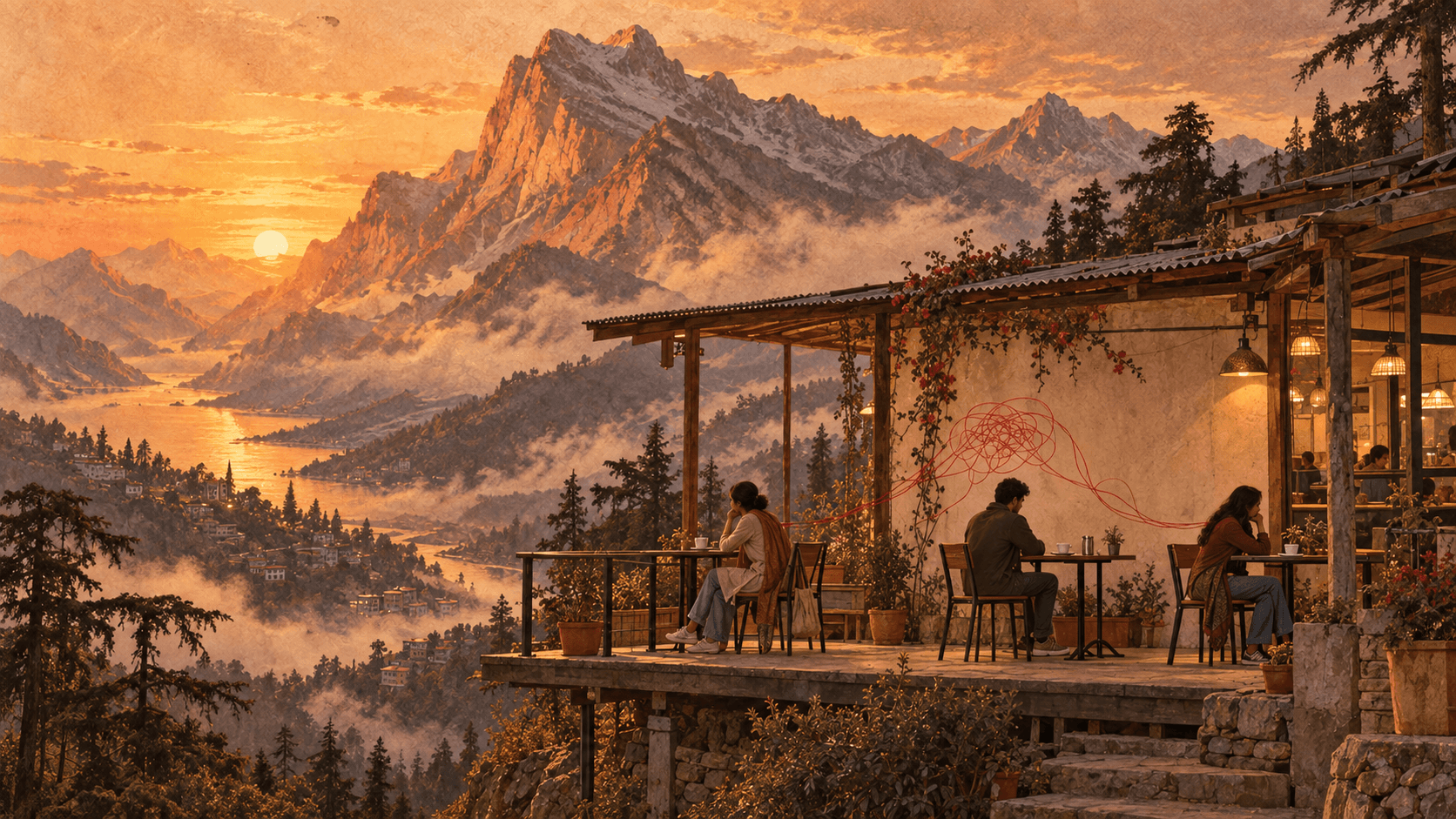
The mountains make all this nonsense easier to romanticise. Poor decisions happen against misty hills, inside a beautiful café, accompanied by soft music and dialogue about journeys, dreams and finding oneself. The landscape supplies the depth that the writing does not earn.
Move the same story into an ordinary apartment in Noida. Let Chander avoid difficult conversations under a tube light instead of beneath a deodar tree. Let Sudha return while traffic is blaring outside instead of emerging through mountain mist.
Would any of this still look profound?
The mountains function like moral dry-cleaning. Everything comes out softer, prettier and easier to forgive.
The series also repeats that familiar urban fantasy: leave your job, move to the hills, open a cafe and discover your authentic self. I live in the mountains. They are beautiful, but they are not easy. Businesses here deal with seasonal tourism, unreliable supplies, difficult weather, road closures, staffing problems and customers who vanish when the season ends. Unless you have capital, family property, generational wealth or income coming from somewhere else, that dreamy café can shut down within six months.
A cafe does not survive because its owner understands coffee and has experienced heartbreak.
Of course, the series is not required to become a documentary about hospitality economics. But the café reflects its entire approach to storytelling. It loves the feeling of a choice while remaining uninterested in its consequences.
Perhaps that is why the show has found admirers even among people who otherwise have strict opinions about fidelity and commitment. The transgression looks respectable here. Nobody is betraying anyone. They are looking for closure. Nobody is refusing to choose. They are surrendering to destiny.
Apparently, emotional dishonesty becomes acceptable when it is spoken about gently enough.
Maybe audiences are not becoming more liberal about relationships. Maybe we simply forgive behaviour that looks poetic. Attraction becomes destiny. Avoidance becomes vulnerability. A refusal to communicate becomes emotional complexity. Add attractive people, a thoughtful soundtrack and a mountain cafe, and irresponsibility begins to resemble courage.
Everytime Chander said “tum kya ho yaar”, I wanted to thrown something at the screen.
Messy characters can make excellent stories. They do not have to be role models. But a story about emotional complexity should examine the harm its characters cause. It should not use scenery and sentimental dialogue to turn every failure of honesty into evidence of great love.
The mountains do not make people wiser. They do not make relationships purer or cafés financially viable. They do not absolve anyone of the consequences of their choices.
Sometimes a misty hillside is only a misty hillside. Sometimes indecision is only indecision. And sometimes people who speak beautifully about love are simply not very good at practising it.